

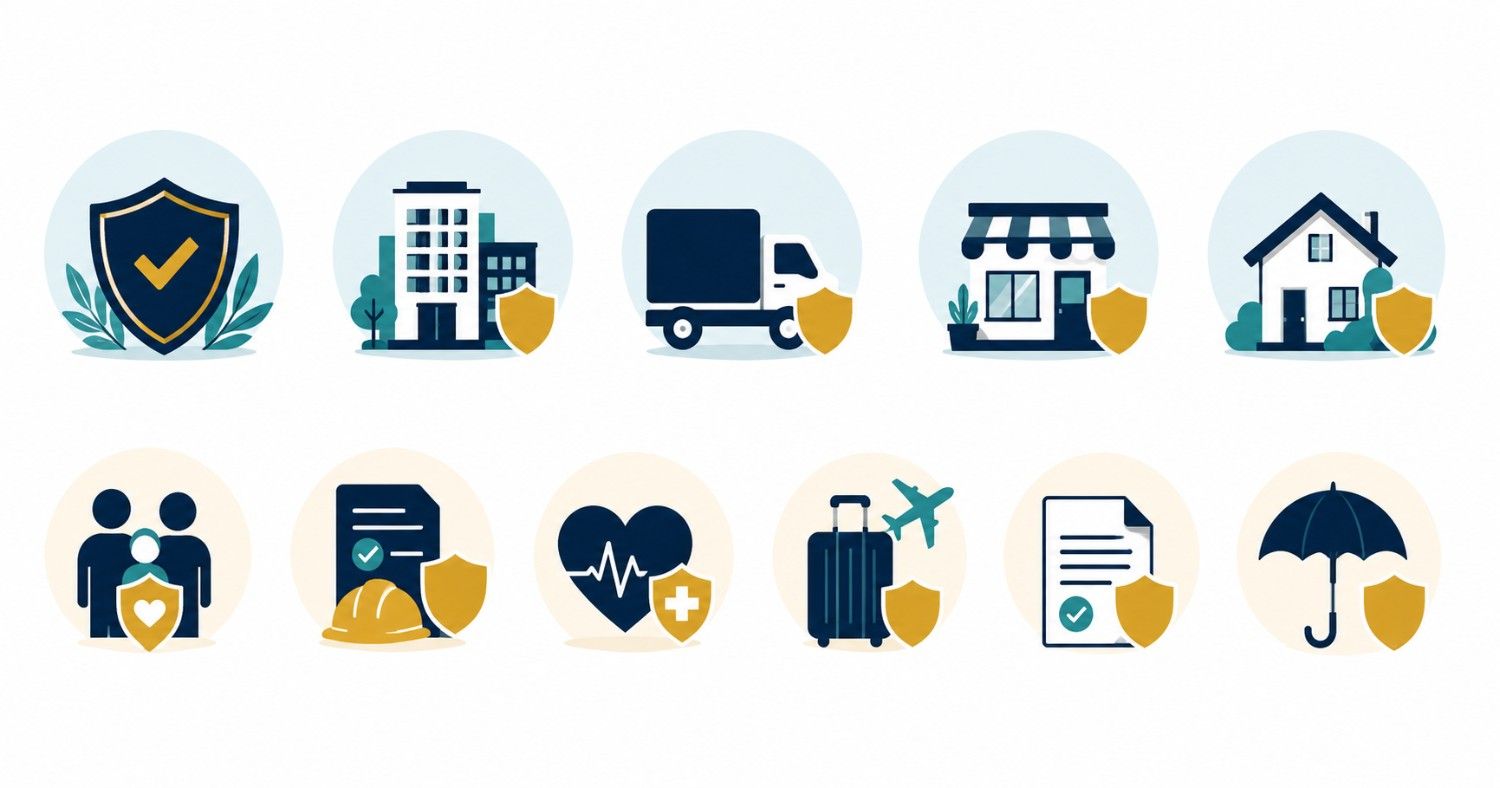
Business insurance is not a single product. It is a category made up of several distinct types of cover, each built to protect against a different kind of risk. South African businesses can choose from a range of these cover types depending on their specific risks, sector, and contractual obligations.
This guide walks through the main types of business insurance available in South Africa, what each one actually covers, and which ones are legally required versus simply good practice.
Want to see all your options in one place?
Compare business insurance options and find the cover types that match your business.
The Main Types of Business Insurance in South Africa
Most businesses end up combining a handful of these cover types into a single policy or a small set of policies, rather than buying every type available. The sections below cover the main categories you are likely to come across while researching cover for your business.
Property and Asset Cover
Property and asset cover protects your physical assets: buildings, contents, stock, equipment, and machinery. It is worth distinguishing between two related but different things. Building cover protects the physical structure itself, which matters if your business owns its premises. The contents cover protects everything inside the building, stock, equipment, furniture, and fittings, which matters to every business, including tenants who do not own their premises.
A tenant renting business premises needs contents cover at a minimum, since the landlord typically insures the building itself. Fire, theft, malicious damage, and weather events are the most common insured perils under this type of cover.
South African context: load shedding and the resulting power surge damage to equipment is a common and growing claim category. Standard property cover does not always include this automatically, so it is worth confirming whether your policy specifically endorses power surge or load shedding-related damage.
Public Liability Insurance
Public liability insurance covers claims from third parties, customers, visitors, or members of the public, for bodily injury or property damage caused by your business operations. A simple example is a customer slipping on a wet floor in your store.
This is one of the most commonly required cover types in South Africa, frequently specified in lease agreements and tender contracts as a condition of doing business. For a full breakdown, see our public liability insurance guide.
Professional Indemnity Insurance
Professional indemnity insurance covers claims arising from professional errors, omissions, or negligent advice, which is a different kind of risk from public liability. Where public liability responds to physical injury or property damage, professional indemnity responds to financial loss caused by your professional work or advice.
It is particularly relevant to financial advisers, lawyers, engineers, architects, accountants, IT consultants, and other professionals whose clients rely on their advice or deliverables. Financial services providers are required to hold this cover under the FAIS Act. For more details, see our professional indemnity insurance guide.
Business Interruption Insurance
Business interruption insurance covers the loss of income your business suffers when it cannot operate following an insured event, such as a fire, flood, or structural damage to your premises. It is designed to keep your fixed costs, such as rent and salaries, covered while you recover.
A key concept here is the indemnity period, which is the length of time your income loss is covered for. Setting this correctly matters, since a period that is too short can leave you without cover before your business has actually recovered.
South African context: civil unrest events and extended load shedding in recent years have both highlighted real gaps in business interruption coverage for many South African businesses, often because indemnity periods or trigger events were not matched to the actual risks faced.
Vehicle and Fleet Insurance
Vehicle insurance for businesses splits broadly into two categories. Commercial vehicle cover suits businesses with one or two vehicles. Fleet insurance covers multiple vehicles under a single policy, usually once a business has three or more, and often includes any-driver cover as a key benefit, allowing any authorised employee to drive any insured vehicle.
For a full breakdown, see our fleet insurance guide. If your business or income depends specifically on app-based ride-hailing, see our e-hailing driver insurance guide instead, since this is a specialist sub-type with its own requirements.
Not sure which types apply to your business?
Check what cover your business needs and get a clear answer before you request quotes.
Employer’s Liability and COIDA
COIDA, the Compensation for Occupational Injuries and Diseases Act, requires South African employers with employees to register and contribute, providing cover for occupational injuries and diseases suffered by staff. This registration is compulsory, not optional.
Many business owners assume COIDA covers everything related to employee risk, but it has real limitations in scope and payout. Employer’s liability insurance is a separate commercial product that fills these gaps, covering situations and claims that fall outside what COIDA provides. The two are related but distinct, and confusing them can leave a business with less protection than it assumes it has.
Goods in Transit Insurance
Goods in transit insurance covers stock or cargo while it is being transported between locations, by road, rail, or courier. This is a different risk to the vehicle itself, which is why it is worth distinguishing clearly from fleet insurance: fleet insurance covers the vehicle, goods in transit covers what is inside it.
This type of cover is common for retail, manufacturing, and wholesale businesses that regularly move stock between warehouses, stores, or to customers, where the value of goods in any single shipment could represent a meaningful loss if damaged or stolen in transit.
Cyber Insurance
Cyber insurance helps with financial losses and liability that can come from cyberattacks, data breaches and ransomware incidents. In South Africa, as SMEs keep leaning more on digital systems, cloud storage, and online payment processing, this whole kind of risk has climbed a lot, but still, many firms do not really grasp how much they can be exposed.
It is worth being clear that standard property and liability policies generally do not cover cyber incidents at all. This is a distinct, growing product category in South Africa, and businesses that hold customer data, process online payments, or depend heavily on digital systems should consider it as a deliberate addition rather than assuming existing cover extends to it.
Event Liability Insurance
Event liability insurance covers one-off or recurring events, such as corporate functions, weddings, or festivals, against claims from attendees or third parties injured or whose property is damaged during the event. For a full breakdown, including single event cover options, see our event liability insurance guide.
Which Types of Business Insurance Are Compulsory in South Africa?
Despite the wide range of products available, only a small number of cover types are actually compulsory by law:
- COIDA registration. Compulsory for any employer with employees.
- Professional indemnity cover for FSPs. Compulsory under the FAIS Act for financial services providers.
- Motor vehicle third-party cover. Required for registered vehicles, including business vehicles.
All other types of business insurance covered in this guide are commercially important, and in many cases practically essential given contractual or landlord requirements, but they are not universally compulsory by law in the way the three categories above are.
Ready to put the right cover in place?
Get a business insurance quote today and compare options from South African insurers.
Frequently Asked Questions
What are the main types of business insurance in South Africa?
The main types include property and asset cover, public liability coverage, professional indemnity protection, business interruption insurance, vehicle and fleet coverage, employer’s liability, goods in transit insurance, cyber insurance and event liability, sort of. Most businesses mix a handful of those options depending on their particular risks, rather than keeping every single type available.
Which type of business insurance is compulsory?
In South Africa, only a small number of cover types are, legally speaking, compulsory: you’ve got COIDA registration for employers who have employees, then professional indemnity cover for financial services providers in terms of the FAIS Act, and also third-party motor vehicle cover for vehicles that are properly registered. Beyond that, the other cover types are still commercially important, but they’re not required across the board by law, so not everyone will have the same obligation.
Do I need all types of business insurance?
No. The right combination really depends on your specific business, its assets, its day-to-day activities, and all those contractual commitments. A consulting firm with no premises and no vehicles ends up with much different needs from a retail store with stock, people, and a public-facing spot. The whole point is fitting the coverage to the real risk, not just grabbing everything that exists on the shelf.
What is the difference between public liability and professional indemnity?
Public liability covers bodily injury or property damage that shows up from how your business is operating. Professional indemnity covers monetary loss from professional mistakes, lack of service or negligent advice, and here there’s no physical injury involved. Many businesses that both interact with the public and provide professional services need both types of cover.
Can I bundle different types of business insurance into one policy?
Yes. Many South African insurers kinda do this by offering combined business policies, where they bundle property, liability and a few other areas together into one policy. Instead of getting separate policies for each risk, you get one schedule and one renewal date. Whether this approach fits your business more than having separate policies really depends on your own risk profile, and also which insurers you end up comparing.
Last reviewed: June 2026. This guide is reviewed periodically to reflect current South African insurance regulation. Insurance in South Africa is regulated by the Financial Sector Conduct Authority (FSCA) under the Insurance Act 18 of 2017. Employer obligations are set out under COIDA, and financial services provider requirements fall under the FAIS Act.
This article is part of our complete business insurance guide. For tailored guidance on what your business specifically needs, visit our business insurance help guide. To learn more about who we are, visit our About page, or read our Privacy Policy for details on how your information is handled when you request a quote.




0 Comments